Superhawk AI just went multiplayer
Why the next great work tool isn't a smarter agent — it's a shared one.
Every category-defining work tool of the last twenty years won the same way: it went multiplayer.
Word was a better typewriter. Google Docs was a room. Photoshop was a better darkroom. Figma was a room. In each case the incumbent had the better feature list and lost anyway, because the moment a tool stops being a thing you use alone and becomes a place your team stands in together, the comparison stops being about features.
AI hasn't had that moment yet. That has been bothering me for a year: agents are the most powerful new capability a team has, and they're the one thing everybody still uses by themselves. You open a chat. You type. You get an answer in a box nobody else can see. If you want a colleague involved, you send them a link to a transcript they can read and can't touch.
That's a single-player tool with a very good engine in it.
It matters more every month, because agents are no longer answering questions in ten seconds. They're running work that unfolds over hours and days — the kind of work that was never a solo activity in the first place. A quarterly business review isn't one person's output. Neither is a root cause analysis, a renewal strategy, or a roadmap decision. Those things pull in a CSM, a manager, Support, Product, sometimes Legal. Handing that work to a private chat window is like drafting a contract by emailing a Word attachment around. It functions. It's just the wrong shape.
So we rebuilt ours.
The tax nobody put on the invoice
Post-sales is the extreme case of this problem, which is why we started here.
An account is the most context-heavy object in a company. It's eighteen months of calls, a support history, a usage curve, three champions (one of whom just left), a success plan, an unresolved security review, and a set of promises made on a Tuesday that everyone's memory of differs slightly on. A CSM/AM carries all of it in their head.
And then the moment the work needs to move, they spend forty minutes putting it into someone else's head. Briefing the manager before the review. Briefing Support before the escalation. Briefing the PM before the roadmap conversation. Briefing the AI, from scratch, every single time.
We call this the collaboration tax, and it's not a communication problem. It's a context problem. It's the reason “AI at work” has so far mostly meant a lot of copying and pasting, and the reason teams that adopted AI enthusiastically often can't point to where the leverage went. Every agent is brilliant and alone, on its own island, and every boundary between islands is paid for in human hours.
What we shipped
Collaborate makes every piece of work in Superhawk a live, shared session.
Tag a peer, a manager, another team — or a Superhawk agent — and they don't arrive at a blank thread asking what this is about. They arrive inside the work, holding exactly what you're holding: the account graph, the call history, the usage trajectory, the open tickets, the earlier drafts and the reasoning behind them. Nobody gets briefed. Everybody is already in.
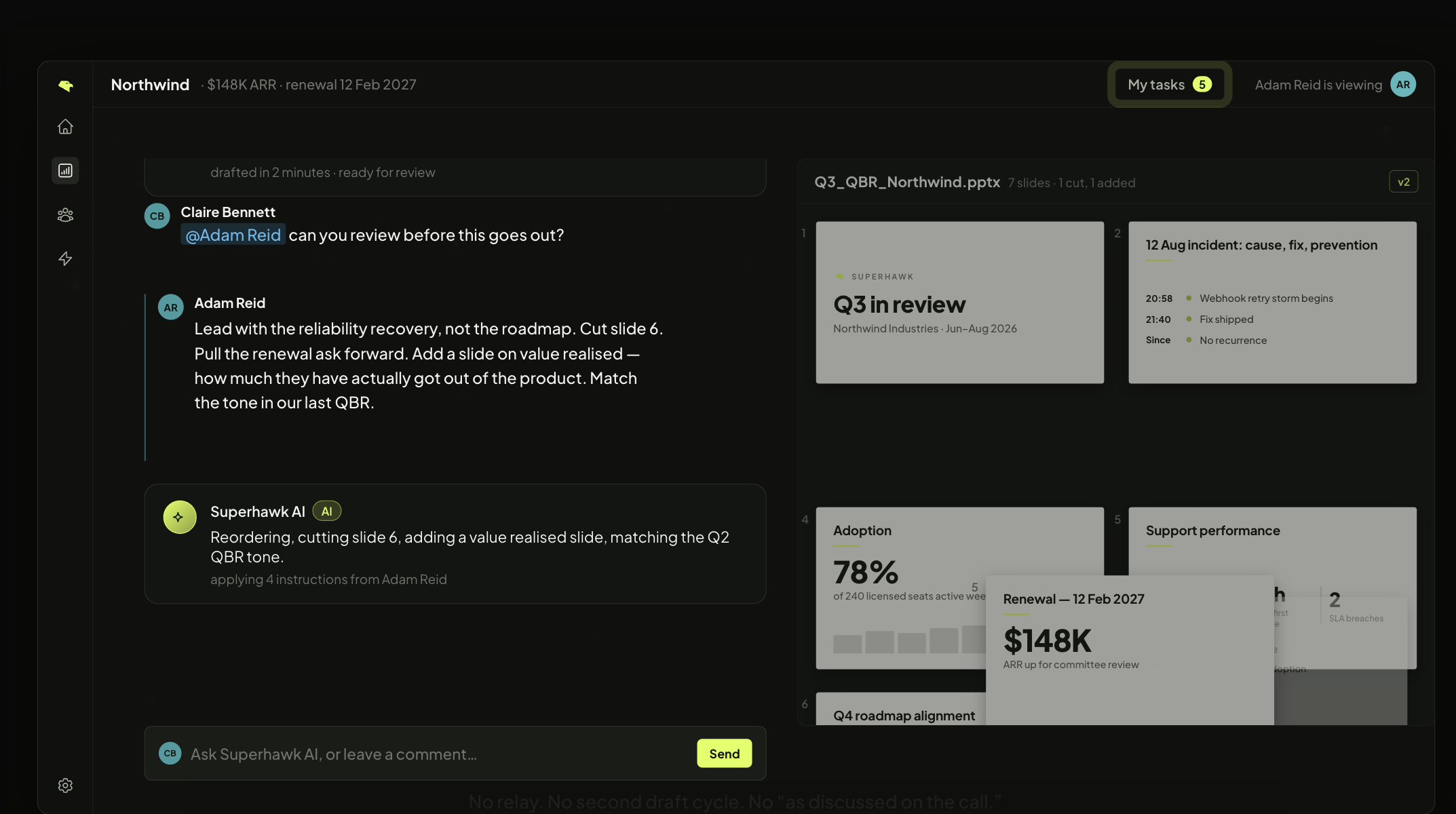
The loop looks like this. You ask the agent to build something. It builds a first version off the account's actual context, not off your prompt. You tag your manager. They open the notification and are standing where you're standing — same draft, same evidence, same agent, same thread. They give feedback in chat, in your session, and a new version appears. When it's right, Finalise turns the session into the real artifact — a deck, a customer-ready doc, an email, a plan — and you send it from the same screen. The thinking and the deliverable were never separate things, so you never move between them.
What that actually looks like on a Tuesday
The QBR. Ask for it. The agent pulls two quarters of adoption, the value realised score and what's still unrealised, the support burden, the champion map, the expansion thesis. You drag the usage view you want onto slide four. Then you tag your manager — who owns the number and will push on the ask. Instead of leaving comments on a deck they'd need walking through, they rewrite the expansion slide in chat, looking at the same evidence you looked at. Finalise, and book the QBR invite with the deck attached without opening another tab.
The RCA. A P1 hits a top-20 account. The agent assembles the analysis from what's already in the graph: the ticket timeline, the error signature, the call three weeks ago where the customer first flagged the symptom, who was in the room, what was promised. You tag the Support lead to correct the sequence and the engineer to sign off on the fix. Two rounds, in-session, in minutes. Finalise and email it to the champion and their CIO while speed still counts as an apology.
The product ask. Not a Slack message saying “customer really wants SSO for sub-orgs.” A session your PM walks into where the ask is already clustered across every account raising it, with ARR attached, the exact call moments quoted, and the two renewals where it's a stated condition. They ask their questions in the same session and get answers grounded in the same data. Roadmap conversations stop being anecdote versus anecdote.
The post-call update. Straight out of a call: security review slipped to Q3, Priya moved teams, the new economic buyer is their VP Ops, they want the migration plan before they'll commit. Drop it in. The agent reconciles it against everything it already knows, updates the success plan, revises the renewal risk, adjusts the tasks. Your manager's Monday review reflects it and you wrote no update at all. Context stops being something you transmit and becomes something the team stands on.
Why this isn't a bot in a channel
The obvious question is whether this is just @-mentioning an assistant in Slack. Three reasons it isn't.
A bot in a thread is a stranger you onboard every time. It sees the last twelve messages; it doesn't see the last twelve months. Our agents work on top of a context graph that has been reconciling this account continuously — which means the first draft is already informed, and the value of the session doesn't depend on how well you wrote the prompt.
A bot replies to a message. Our agents work on an artifact, and version it. The unit of collaboration is the thing you're going to ship, not the conversation about it.
And a bot's output lands in a channel, where work goes to decay. Sessions in Superhawk finalise into deliverables and send from where they were made — and everything learned in them compounds back into what the team knows next time. A thousand private chats produce a thousand private lessons. Shared sessions produce an organisation that gets smarter.
From early users
“I used to spend the first ten minutes of every review explaining the account before we could talk about the account. Now my manager just walks into the session and we're straight into the decision.”
“Our RCA turnaround went from four days to the same afternoon. Support, engineering and I were editing one thing instead of three.”
“The product asks changed the tone of the roadmap conversation completely. It's not me lobbying anymore. The evidence is sitting right there next to the request.”
The bigger bet
There's a version of this for every kind of work — engineers building together, analysts on one model, lawyers on one contract, marketers on one campaign. Anywhere a team already crowds around a single problem, the agent in the middle should be shared rather than cloned into a dozen private windows.
We're building it for the post-sales revenue org, because that's where the context is deepest, the handoffs are most expensive, and the cost of a stale picture is a renewal. But the underlying conviction is general: the winning AI products won't be the ones with the smartest solo agent. They'll be the ones where the work stopped being solo.
Multiplayer won every time before. It's going to win again.
Collaborate is available now in every Superhawk workspace. Open an account, start a session, and @ someone or @ superhawkAI.